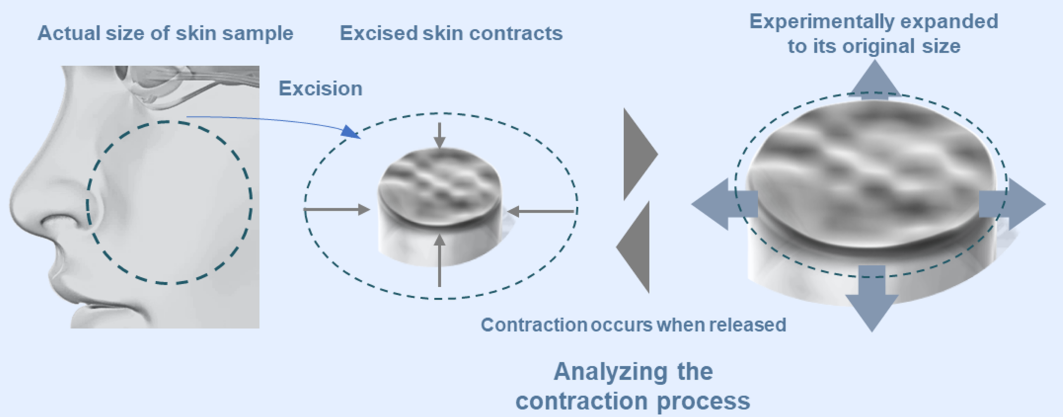








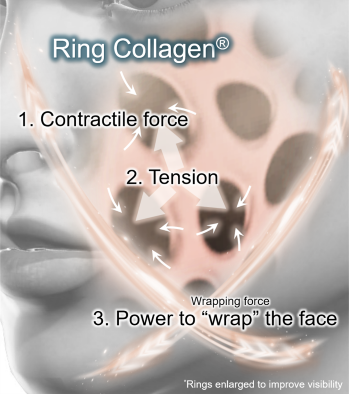
Conducted with Kyoichi Matsuzaki, head of the outpatient plastic surgery department at the Faculty of Medicine of the’International University of Health and Welfare, and researchers from Jichi Medical University and the National Institute for Physiological Sciences, the study revealed ring-shaped collagen structures. These rings contract locally and pull on one another, generating distributed tension in the skin.
Ring Collagen tightens the skin
In excised young facial skin, contraction occurs rapidly. The analysis, conducted using Digital-Skin Reality, revealed areas where the force is strong and ring-shaped. In these regions, collagen takes on a ring-like shape. This mechanism helps to envelop the face and contributes to maintaining a defined contour.
Age-Related Changes and Areas for Improvement
Collagen rings have been observed around vellus hairs and sebaceous glands, surrounded by proteoglycans. With aging, the decrease in these proteoglycans is accompanied by a disruption of the ring-like structure, reducing tension and promoting sagging. Moderate physical stimulation, through multidirectional stretching of cultured skin, increased the amount of associated proteoglycans and improved the observed architecture. Extracts of rosehip and safflower also promoted the expression of genes related to proteoglycans.
Digital-Skin Reality visualizes forces in 3D
AI technology places a high density of observation points within the tissue, tracks their movements during contraction, and then reconstructs the intensity of the forces in 3D. Autostereoscopy, combined with high-speed data processing, displays a «skin» a digital representation that evolves in real space. It provides access to the world of forces, beyond mere visible structures and movements.
Some of the results were presented at the 32nd IFSCC Congress in London in September 2022 and were selected as one of the ten finalists. The congress also scheduled a plenary session on this research. This scientific visibility places Ring Collagen and Digital-Skin Reality within an academic evaluation framework, ahead of potential applications.