







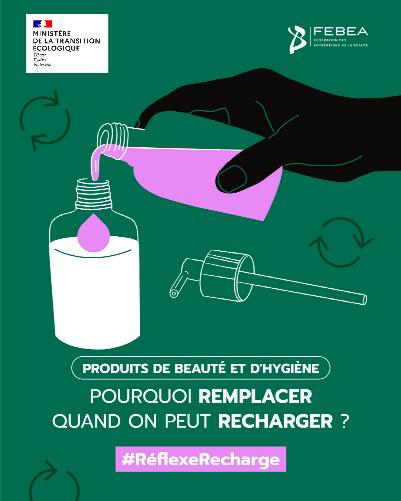
The Federation of Beauty Companies (Febea) is launching a national campaign titled «Why replace when you can recharge?» on International Recharge Day, June 16, 2026. The stated goal is to raise awareness of rechargeable products and make the "#RéflexeRecharge" habit a part of everyday shopping routines.
59% of female consumers report having purchased a refill
The study conducted by Senseva for Febea in June 2025 indicates that 59% of female cosmetics consumers report having purchased refills in the past year. The survey includes a quantitative phase conducted online from April 20, 2025, to May 1, 2025, among 2,251 female cosmetics consumers, representative in terms of age, socio-professional category, and geographic distribution.
Identified barriers: availability and information
The report highlights barriers to adoption: limited availability in stores, a lack of clear information, and a lack of awareness that refills are available for certain product categories. Febea notes that refills are now available for a wide range of product categories—shampoo, perfume, lotion, hair care, cleansers, makeup removers, and makeup—and that they extend beyond just personal care products.
Emmanuel Guichard, Executive Director of Febea, notes that «Refilling meets three very specific consumer needs: reducing packaging, managing one’s budget, and simplifying certain daily tasks. The challenge now is to make this solution more visible, more understandable, and more intuitive at the point of purchase.»
According to Stéphanie Lumbers, Director of Sustainable Development at Febea, «Refilling is a simple yet powerful action: it extends the life of containers, reduces packaging, and, in many cases, helps you better manage your budget. The challenge now is to make it more obvious at the point of purchase.»
More than a dozen cosmetic brands will join the campaign on the same day by promoting their refill options. Febea is calling for clearer labeling of refillable formats—such as pouches, cartridges, cups, compact refills, or transfer bottles—to make it easier for consumers to use them.
Collective action aims to turn an occasional choice into a habitual purchasing decision and to reduce packaging waste on a large scale by extending the lifespan of primary containers.